
Buderim Glasshouse
The brief was to create a comfortable, low maintenance home to maximise the views of the Glasshouse Mountains and the Ocean. The clients wanted a space-efficient plan without too many patios or unused, wasted space; a home that will not feel dated and has enough space for the family now but isn’t so big that when the kids leave home they need to downsize.
As it was one of the last homes to be built in the area, the clients also wanted to minimise its impact on the neighbours’ views.
The clients were architecture and design enthusiasts and wanted a home that was unique and interesting. In the words of the owner “we were attracted to the simplicity of Norman’s designs and his ability to integrate a building into its surroundings.”
Site constraints
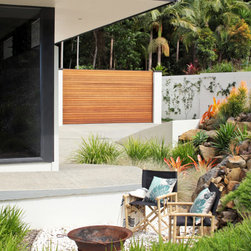
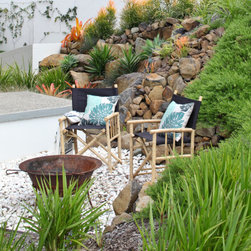
Two previous owners had attempted to build on the site and gave up because of the serious site constraints which included the steep and unstable site and the truncation of the 2600sqm block with numerous easements and an intermittent water course along one edge. The home fits within the easements with no space to spare. Site investigations revealed the site had been used previously as a quarry and a dumping ground for rock and spoil and a spring was discovered onsite during construction. The ground floor concrete slab was engineered as a suspended bridge to minimize site impact.
Climate response
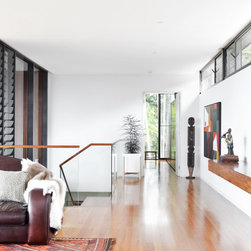
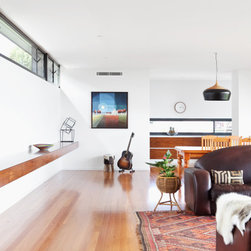
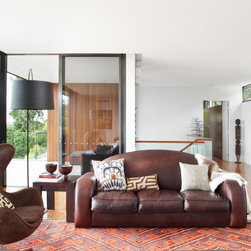
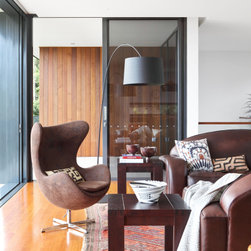
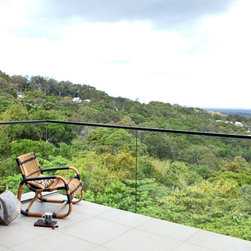
The block is located on the south side of Buderim Mountain. Views are due south into the prevailing weather including subtropical storms. Instead of building large decks that wouldn’t be used on many days, and to be space efficient, the southern living room wall is floor to ceiling glass that retracts to transform the living space into an outdoor space. Clerestory ribbon windows let the northern winter sun in while preserving privacy from the neighbours further further up the slope.
Sun studies determined the ideal overhang sizes and glazing locations and grey tinted glass was specified. The home is one room deep to maximise natural ventilation.
Design concept
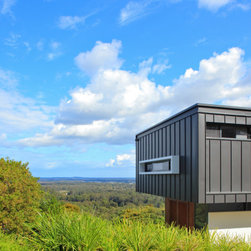
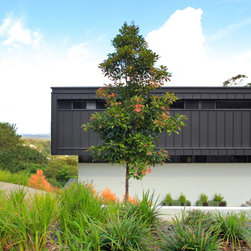
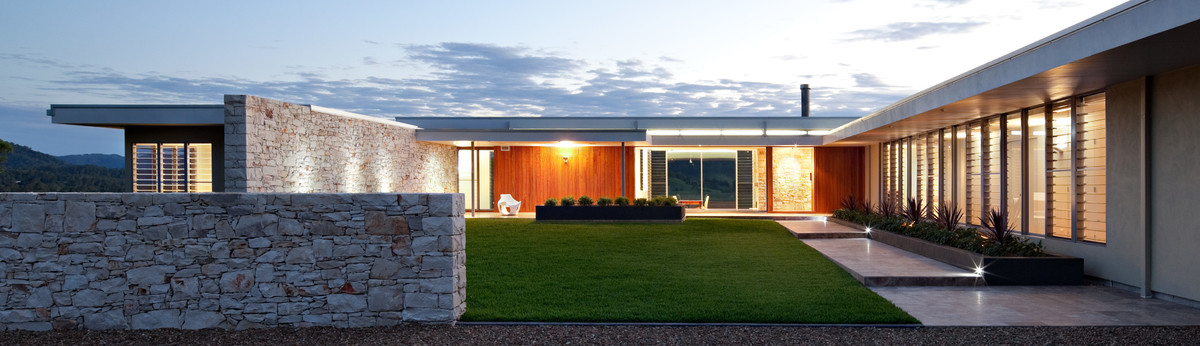
The intent was to increase the natural drama of the site without dominating it. This was achieved through the contrast between how it appears from the street - opaque and impermeable to glassy and transparent from inside.
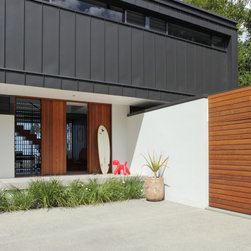
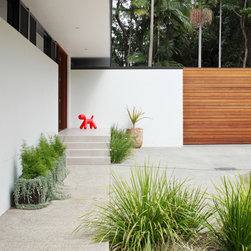
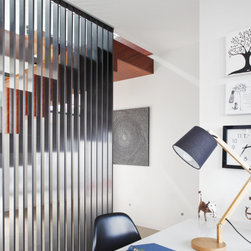
The spacial sequence begins in a compact forecourt with no views, the views are gradually revealed with a tease in the foyer through a batten screen opening up to the full panorama upstairs.
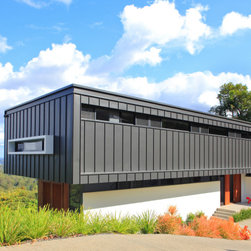
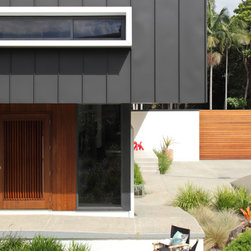
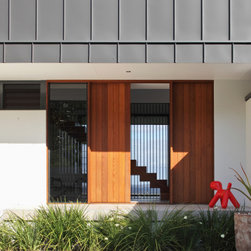
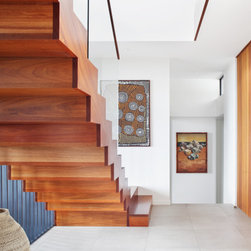
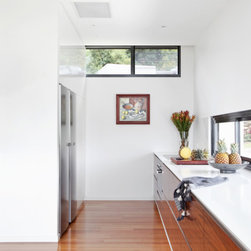
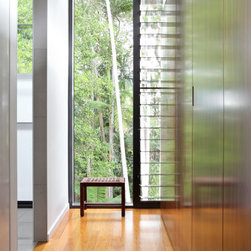
Formally the concept is a black metal frame floating on a white solid masonry base. The floating frame is repeated in the interior design with white Corian providing a seamless look with integrated basins contrasted with American Walnut infill. Detailing is minimalist - the structure and fixings are concealed.
As it was one of the last homes to be built in the area, the clients also wanted to minimise its impact on the neighbours’ views.
The clients were architecture and design enthusiasts and wanted a home that was unique and interesting. In the words of the owner “we were attracted to the simplicity of Norman’s designs and his ability to integrate a building into its surroundings.”
Site constraints
Two previous owners had attempted to build on the site and gave up because of the serious site constraints which included the steep and unstable site and the truncation of the 2600sqm block with numerous easements and an intermittent water course along one edge. The home fits within the easements with no space to spare. Site investigations revealed the site had been used previously as a quarry and a dumping ground for rock and spoil and a spring was discovered onsite during construction. The ground floor concrete slab was engineered as a suspended bridge to minimize site impact.
Climate response
The block is located on the south side of Buderim Mountain. Views are due south into the prevailing weather including subtropical storms. Instead of building large decks that wouldn’t be used on many days, and to be space efficient, the southern living room wall is floor to ceiling glass that retracts to transform the living space into an outdoor space. Clerestory ribbon windows let the northern winter sun in while preserving privacy from the neighbours further further up the slope.
Sun studies determined the ideal overhang sizes and glazing locations and grey tinted glass was specified. The home is one room deep to maximise natural ventilation.
Design concept
The intent was to increase the natural drama of the site without dominating it. This was achieved through the contrast between how it appears from the street - opaque and impermeable to glassy and transparent from inside.
The spacial sequence begins in a compact forecourt with no views, the views are gradually revealed with a tease in the foyer through a batten screen opening up to the full panorama upstairs.
Formally the concept is a black metal frame floating on a white solid masonry base. The floating frame is repeated in the interior design with white Corian providing a seamless look with integrated basins contrasted with American Walnut infill. Detailing is minimalist - the structure and fixings are concealed.