

How Plumbing Takeoff Software Uses AI to Speed Bids Without Sacrificing Trust
In commercial plumbing preconstruction, the word "automation" often triggers immediate alarm bells. For a trade where a miscalculated sanitary slope or a forgotten series of copper fittings can completely wipe out a project’s profit margin, the promise of "lightning-fast AI" sounds reckless. To a veteran estimator, speed without verification is just a faster way to lose money.
For decades, generating accurate construction takeoffs in the plumbing sector required grueling, manual verification. Estimators meticulously traced every linear foot of pipe and manually counted every single elbow, tee, and wye to ensure nothing was missed.
Today, the most profitable mechanical contractors are adopting AI-driven plumbing takeoff software, but they aren’t doing it blindly. They are utilizing platforms that are specifically engineered to build an impenetrable, visual audit trail. Here is the contrarian truth about modern estimating: artificial intelligence doesn’t ask you to trust a "black box"—it gives you the exact data you need to verify the bid faster than ever before.
The Root of the Skepticism: Why Plumbers Fear "Fast" Estimating
Before we look at how modern algorithms build confidence, we have to understand why traditional digital tools broke that trust in the first place.
The Flaws of the 2D Digital Digitizer
When a plumbing estimator uses legacy on-screen takeoff software, the tool is entirely passive. It requires the human hand to trace a flat line over a two-dimensional PDF to measure a pipe.
When your baseline data is built on flat measurements and blanket percentage assumptions, trusting the final bid amount is nearly impossible.
How AI Plumbing Takeoff Software Engineers Trust
True artificial intelligence fundamentally shifts the dynamic between the estimator and the software. Instead of generating a blind output, advanced plumbing takeoff software acts as a meticulous, high-speed junior estimator that shows its work on every single page.
The Power of Algorithmic Cross-Referencing
Modern AI does not look at a floor plan in a vacuum. It actively parses the geometric relationships across the entire plan set simultaneously to validate its findings.
Reading the Risers
To calculate the true reality of a plumbing system, the algorithm cross-references the flat floor plans with the isometric riser diagrams.
By mathematically calculating the exact linear footage and fitting counts, the AI completely eliminates the need for dangerous "guesstimates" and bloated waste percentages.
Transparency Over "Black-Box" Magic
The defining feature of enterprise-grade construction takeoffs generated by AI is radical transparency. You should never submit a bid based on a number you cannot visually verify.
The Visual Audit Trail
When the AI completes its automated scan of the blueprints, it does not just hand the estimator an Excel spreadsheet. It generates a comprehensive visual overlay directly on the digital plans.
This level of traceability ensures that the senior estimator retains total control over the data. The AI does the heavy lifting of the extraction, but the human validates the logic.
The Addendum Defense: Protecting the Margin
Trust is most easily broken in the chaotic 48 hours before a bid is due, when the architectural team drops a revised plan set.
Automated Variance Tracking
Historically, an addendum meant throwing the original manual takeoff in the trash and starting over, rushing to hit the deadline. This panic is where catastrophic margin errors occur.
Modern AI platforms neutralize this risk entirely. The software runs a pixel-by-pixel comparison between the original drawing and the revised addendum. It instantly generates a Variance Report, explicitly highlighting exactly what pipe runs were re-routed, what fixtures were deleted, and what material quantities shifted. It acts as an unblinking safety net when human stress levels are at their highest.
The Human-in-the-Loop Imperative
The most successful mechanical contractors do not view AI as a replacement for their estimating team. They view it as a high-powered data extraction tool that frees their team to focus on strategic risk management.
Speeding Up the Count to Slow Down the Strategy
When the plumbing takeoff software reduces the data extraction phase from five days down to five hours, the estimator reclaims their workweek.
They can use that reclaimed time to build undeniable trust in the final proposal by:
Conclusion: Verification is the New Speed
The narrative that AI will blindly automate the plumbing estimator out of a job is a myth pushed by bad marketing. Plumbing is too heavily regulated by code, physics, and complex field logistics to trust an algorithm with the final price tag.
However, contractors who refuse to adopt advanced plumbing takeoff software are severely handicapping their bid volume. By embracing "Human-in-the-Loop" automation, estimators can drastically speed up the tedious generation of construction takeoffs while maintaining absolute, visual control over the data. When you have a mathematically verified, visually audited baseline, you aren't just bidding faster—you are bidding with absolute, unshakeable confidence.
For decades, generating accurate construction takeoffs in the plumbing sector required grueling, manual verification. Estimators meticulously traced every linear foot of pipe and manually counted every single elbow, tee, and wye to ensure nothing was missed.
Today, the most profitable mechanical contractors are adopting AI-driven plumbing takeoff software, but they aren’t doing it blindly. They are utilizing platforms that are specifically engineered to build an impenetrable, visual audit trail. Here is the contrarian truth about modern estimating: artificial intelligence doesn’t ask you to trust a "black box"—it gives you the exact data you need to verify the bid faster than ever before.
The Root of the Skepticism: Why Plumbers Fear "Fast" Estimating
Before we look at how modern algorithms build confidence, we have to understand why traditional digital tools broke that trust in the first place.
The Flaws of the 2D Digital Digitizer
When a plumbing estimator uses legacy on-screen takeoff software, the tool is entirely passive. It requires the human hand to trace a flat line over a two-dimensional PDF to measure a pipe.
- The Z-Axis Blind Spot: A standard digital ruler only measures the horizontal run. It cannot see the 12-foot vertical drop down a chase, or the complex offsets required to bypass an HVAC duct.
- The Fatigue Factor: An estimator staring at a dense, overlapping mechanical room schematic for six hours will inevitably miss critical symbols due to visual exhaustion.
- The Fitting Trap: Because passive software cannot calculate the vertical plane, it cannot accurately count the fittings required for those directional changes. Estimators are forced to rely on historical "fitting multipliers" (e.g., adding 15% to the linear footage) rather than an exact count.
When your baseline data is built on flat measurements and blanket percentage assumptions, trusting the final bid amount is nearly impossible.
How AI Plumbing Takeoff Software Engineers Trust
True artificial intelligence fundamentally shifts the dynamic between the estimator and the software. Instead of generating a blind output, advanced plumbing takeoff software acts as a meticulous, high-speed junior estimator that shows its work on every single page.
The Power of Algorithmic Cross-Referencing
Modern AI does not look at a floor plan in a vacuum. It actively parses the geometric relationships across the entire plan set simultaneously to validate its findings.
Reading the Risers
To calculate the true reality of a plumbing system, the algorithm cross-references the flat floor plans with the isometric riser diagrams.
- Vertical Detection: By reading the text callouts (e.g., "Drop to Invert" or "Up to Fixture"), the AI automatically calculates the hidden vertical linear footage and injects it into the bill of materials.
- Granular Fitting Extraction: Because the AI understands that a pipe is changing direction across multiple planes, it autonomously identifies and tallies the exact number of 90-degree elbows, 45-degree offsets, and wyes required to make the connection code-compliant.
By mathematically calculating the exact linear footage and fitting counts, the AI completely eliminates the need for dangerous "guesstimates" and bloated waste percentages.
Transparency Over "Black-Box" Magic
The defining feature of enterprise-grade construction takeoffs generated by AI is radical transparency. You should never submit a bid based on a number you cannot visually verify.
The Visual Audit Trail
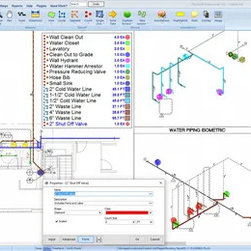
When the AI completes its automated scan of the blueprints, it does not just hand the estimator an Excel spreadsheet. It generates a comprehensive visual overlay directly on the digital plans.
- Color-Coded Verification: Every domestic water line, sanitary sewer, and vent pipe is distinctly color-coded. An estimator can instantly look at the screen and verify that the AI correctly differentiated the hot water supply from the chilled water return.
- Click-to-Source Traceability: If the AI lists 42 cast-iron cleanouts on the material list, the estimator can click that line item, and the software will instantly zoom in and highlight the exact location of all 42 cleanouts on the plans.
This level of traceability ensures that the senior estimator retains total control over the data. The AI does the heavy lifting of the extraction, but the human validates the logic.
The Addendum Defense: Protecting the Margin
Trust is most easily broken in the chaotic 48 hours before a bid is due, when the architectural team drops a revised plan set.
Automated Variance Tracking
Historically, an addendum meant throwing the original manual takeoff in the trash and starting over, rushing to hit the deadline. This panic is where catastrophic margin errors occur.
Modern AI platforms neutralize this risk entirely. The software runs a pixel-by-pixel comparison between the original drawing and the revised addendum. It instantly generates a Variance Report, explicitly highlighting exactly what pipe runs were re-routed, what fixtures were deleted, and what material quantities shifted. It acts as an unblinking safety net when human stress levels are at their highest.
The Human-in-the-Loop Imperative
The most successful mechanical contractors do not view AI as a replacement for their estimating team. They view it as a high-powered data extraction tool that frees their team to focus on strategic risk management.
Speeding Up the Count to Slow Down the Strategy
When the plumbing takeoff software reduces the data extraction phase from five days down to five hours, the estimator reclaims their workweek.
They can use that reclaimed time to build undeniable trust in the final proposal by:
- Aggressive Vendor Negotiation: Utilizing the mathematically verified, highly granular bill of materials to lock in bulk pricing with local supply houses.
- Hyper-Targeted Labor Allocation: Applying specific labor rates to complex zones (like a cramped mechanical shaft) because they know the exact fitting count, rather than applying a blanket labor multiplier across the whole job.
- Value Engineering: Analyzing the AI's 3D routing to find cost-saving alternative layouts to present to the general contractor, increasing the chances of winning the project.
Conclusion: Verification is the New Speed
The narrative that AI will blindly automate the plumbing estimator out of a job is a myth pushed by bad marketing. Plumbing is too heavily regulated by code, physics, and complex field logistics to trust an algorithm with the final price tag.
However, contractors who refuse to adopt advanced plumbing takeoff software are severely handicapping their bid volume. By embracing "Human-in-the-Loop" automation, estimators can drastically speed up the tedious generation of construction takeoffs while maintaining absolute, visual control over the data. When you have a mathematically verified, visually audited baseline, you aren't just bidding faster—you are bidding with absolute, unshakeable confidence.