

Rural Australian Homestead
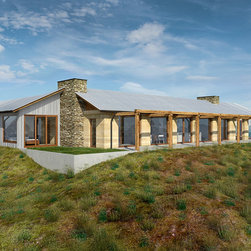
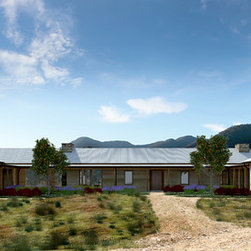
Drawing inspiration from traditional Australian homesteads, this house combines passive solar design and natural materials to create a truly contemporary country home. The design brief called for this house to be flexible: both cosy enough for a couple and grand enough to house an extended family. As such, we took cues from classic rural homesteads like Yanga (Balranald, NSW), Lanyon (Canberra, ACT), and Throsby Park (Southern Highlands, NSW). These homes had a constantly fluctuating workforce as the labor demands of the farm changed throughout the year. The (possibly unintentional yet ingenious) solution of multiple pavilions that could be opened up or shut down allowed for these properties to cater to any situation. The connections between the pavilions varied to suit function, privacy levels, and defined outdoor ‘room’ spaces that protected against the harsh climate.
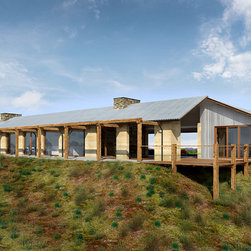
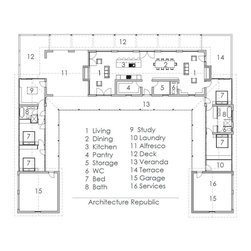
In this home, three pavilions define a courtyard with a formal garden. The eastern pavilion is the most private, containing twin master bedrooms. This connects to the north-facing living pavilion via a combined library/casual living space. The western pavilion, separated from the living pavilion via the alfresco space, contains a study and guest rooms and can be closed off when not in use. This arrangement allows for a variety of outdoor “rooms,” the courtyard, the veranda, deck spaces, alfresco and a terrace. The surrounding pasture comes right up to the outside of the house giving the occupants a commanding view of, and connection to, their property and livestock.
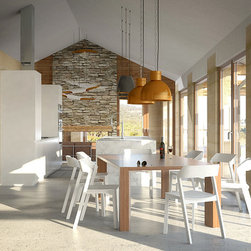
We chose a contemporary yet natural architectural palette of rammed earth, corrugated iron, reclaimed and local timber, and glass. Rammed earth has been used in Australian homesteads since colonial times, often outliving the rest of the house. It performs beautifully in passive solar design, providing thermal mass with a diurnal cycling of heat (meaning, the warmth from the day reaches the interior at night, and the cool of the night reaches the interior by daytime). Off-grid solar-powered hydronic slab heating takes passive solar a step further, storing the heat of the sun as hot water to circulate through the slab, providing reliable warmth throughout winter. The verandas provide shelter on the south, allowing for plenty of natural light to enter all the rooms. We were careful with placement of veranda elements not to darken rooms or restrict the views.
In this home, three pavilions define a courtyard with a formal garden. The eastern pavilion is the most private, containing twin master bedrooms. This connects to the north-facing living pavilion via a combined library/casual living space. The western pavilion, separated from the living pavilion via the alfresco space, contains a study and guest rooms and can be closed off when not in use. This arrangement allows for a variety of outdoor “rooms,” the courtyard, the veranda, deck spaces, alfresco and a terrace. The surrounding pasture comes right up to the outside of the house giving the occupants a commanding view of, and connection to, their property and livestock.
We chose a contemporary yet natural architectural palette of rammed earth, corrugated iron, reclaimed and local timber, and glass. Rammed earth has been used in Australian homesteads since colonial times, often outliving the rest of the house. It performs beautifully in passive solar design, providing thermal mass with a diurnal cycling of heat (meaning, the warmth from the day reaches the interior at night, and the cool of the night reaches the interior by daytime). Off-grid solar-powered hydronic slab heating takes passive solar a step further, storing the heat of the sun as hot water to circulate through the slab, providing reliable warmth throughout winter. The verandas provide shelter on the south, allowing for plenty of natural light to enter all the rooms. We were careful with placement of veranda elements not to darken rooms or restrict the views.
Project Year: 2016
Project Cost: $500,001 AUD - $750,000 AUD
Country: Australia
Postcode: 2576