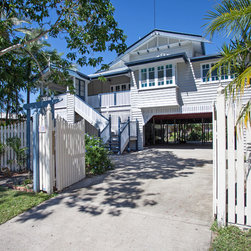


Queenslander Revival - Alteration and Addition
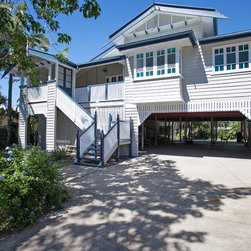
This majestic home was originally built in 1931. This home is steeped in history, is situation on Hinton the street was named after Harold Hinton, a WW1 soldier who was killed in action. The property’s architecture can be best described as an Inter War Porch and Gable house, defined by its casement leadlight windows, front bay windows, triple gables facing the street frontage, and decorative timber detail. The property’s neighbour across the road remembers the home being built when she moved to Hinton Street as a new bride. She is about to turn 103. Mrs. Welsh recalls the house having a number of reincarnations in its time: from a Doctor’s residence and surgery rooms, to a duplex rooming house and more recently as a single dwelling for a family.
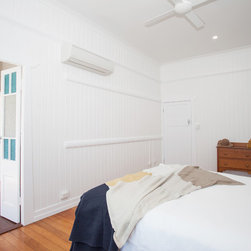
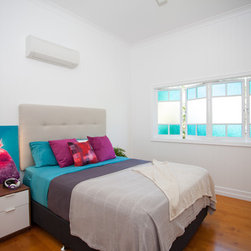
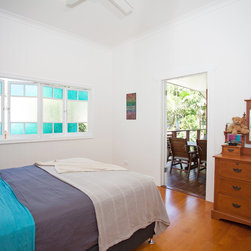
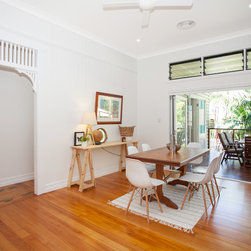
The home owner’s brief; was to restore the existing façade and streetscape, whilst creating an extension that would service the needs of a modern 21st century family. Great care was taken during the design stage to retain the period features of the property including timber casement with clear and aqua Artico glass, internal and external timber fretwork, tongue and groove walls, picture rails and skirting boards, external weatherboard, and hardwood flooring.
The existing floor plan was revised to:
1. Provide more privacy to bedrooms, which originally were all accessible from the main living room
2. Provide a master bedroom with WIR and ensuite
3. Create new kitchen with modernized layout
4. Create a study for both parent and children’s use
5. Create an additional bathroom and an additional separate toilet
6. Maintain crossflow ventilation to minimize hot and stuffy rooms
7. Install wall and ceiling insulation to reduce energy costs
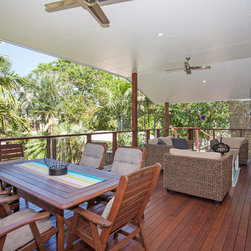
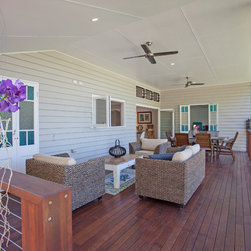
8. Create a rear roofed alfresco area for outdoor living and dining with south easterly aspect to capture the prevailing breezes
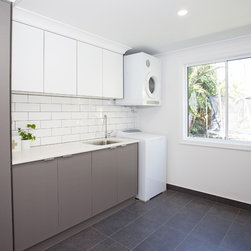
9. Reconstruct the existing ground floor laundry with flood resistant fittings
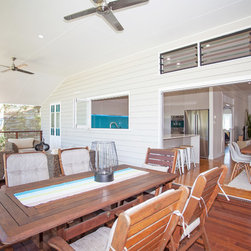
Mackay Regional Council’s Heritage conversation reports were referenced during the design phase. Due to the Flood and Inundation Overlay Planning Schemes, it was not possible to build in under the existing home. In line with the Council’s published Conserving Heritage Houses in the Mackay Region, Urban Trend Construction’s design involved construction of a rear extension, rather than enclosing existing front verandah space, which has often been a typical past renovation practice in the area. A large rear roofed alfresco deck was incorporated to create connection between the indoor and outdoor. The rear extension’s roof pitch and design would match to existing seamlessly, and incorporate gables with infills to match the existing gable detail.
Consultation with local Private Certifiers occurred to ensure the renovation adhered to the Residential Character Area requirements; specifically compatible with the prevailing character of the local area with respect to its siting, scale, form, design and use of external materials. The design’s external features included Zincalume roofing and timber wall cladding to match the existing historical detail.
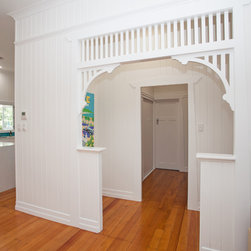
Internally, hand crafted fretwork was carpentered on-site to match existing vertical splayed architrave in hallways. Casement windows and art deco window hardware was sourced from Finlayson’s Hardware in Brisbane. Clear and aqua Artico glass was sourced through Hartley-Williams also located in Brisbane. Hardwood timber boards were sourced locally from Porters Hardware to match existing.
During demolition, hidden treasures were unearthed, including local Daily Mercury newspaper articles, from the assumed last major renovation in 1951. Hidden hazards were also uncovered, as a small amount of asbestos was found, treated and removed from site. During demolition all the existing internal doors, casement windows and French doors were carefully removed, stored on-site and finally restored prior to completion of the project. The high volume of rehoused materials provided cost savings to the overall project.
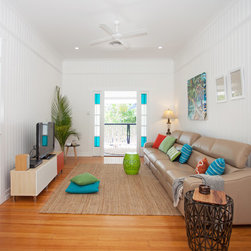
Tongue and groove walling was preserved, and new walling installed where cheaper wall treatments had been applied in years gone past. Multiple layers of paint was stripped and sanded back in mould affected areas. In some rooms, the single skin walls were not replaced, allowing the history of the house (and past usages) to still be viewed. Along the western side of the house, a front porch had been enclosed with aluminum framed louvres at some time in the past. In attempting to improve the street appeal and with a nod to history, new casement windows built to match the ‘hopscotch’ pattern and Artico glass was used as a historically relevant replacement for the old, ugly louvres. Timber weatherboard cladding in the same profile as the original was sourced to match and tie the old and new parts of the home together. Where new door and window hardware were used, they were chosen carefully to ensure that the art deco style of the house was not compromised.
This project provided carpenters, apprentices, glaziers with the opportunity to use techniques and work with materials from the past. The art deco architraves surrounding the each doorway in the house, the finishes to the skirting boards and picture rails, the use of re-claimed VJ boards to patch holes and the construction of door surrounds where French doors were recycled and rehoused to create uniformity between front and rear decks for exits from rooms to the rear deck, were all tasks that required the tradesmen to apply skills that are often not applied to many modern builds.
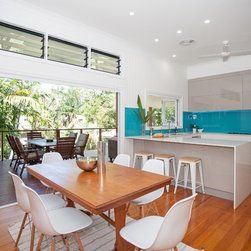
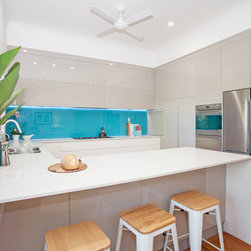
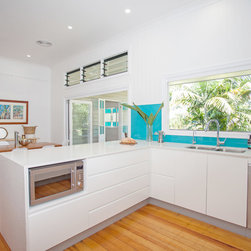
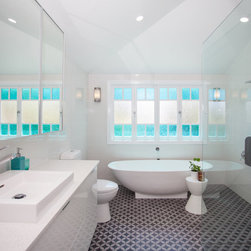
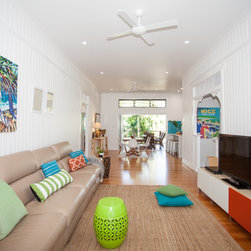
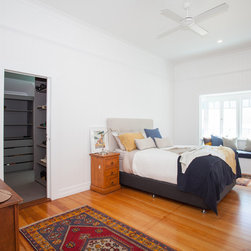
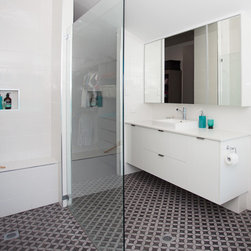
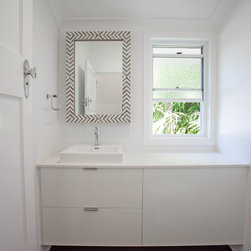
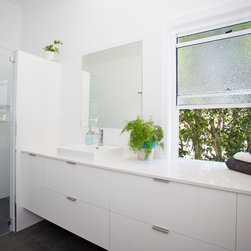
However, this project was not entirely a restoration project. The owner’s desired to integrate all the modern comforts of today, including a fully modern 2pac kitchen with Smeg appliances, new bathrooms with luxurious fittings and floor to ceiling tiles, a new spacious laundry, and centralized study for the family’s technology needs. Plasterboard ceilings were installed to allow for modern lighting, ceiling fans, and air-conditioning. Additional storage was also included with stunning bespoke master walk-in-robe, and built in robes throughout.
The project was completed in February 2015. The complex marriage of old and new has been achieved through making almost no change to the front façade; ensuring that the materials used matched the older heritage items, and the result was a historical house that its latest family can call not a museum, but a home.
The home owner’s brief; was to restore the existing façade and streetscape, whilst creating an extension that would service the needs of a modern 21st century family. Great care was taken during the design stage to retain the period features of the property including timber casement with clear and aqua Artico glass, internal and external timber fretwork, tongue and groove walls, picture rails and skirting boards, external weatherboard, and hardwood flooring.
The existing floor plan was revised to:
1. Provide more privacy to bedrooms, which originally were all accessible from the main living room
2. Provide a master bedroom with WIR and ensuite
3. Create new kitchen with modernized layout
4. Create a study for both parent and children’s use
5. Create an additional bathroom and an additional separate toilet
6. Maintain crossflow ventilation to minimize hot and stuffy rooms
7. Install wall and ceiling insulation to reduce energy costs
8. Create a rear roofed alfresco area for outdoor living and dining with south easterly aspect to capture the prevailing breezes
9. Reconstruct the existing ground floor laundry with flood resistant fittings
Mackay Regional Council’s Heritage conversation reports were referenced during the design phase. Due to the Flood and Inundation Overlay Planning Schemes, it was not possible to build in under the existing home. In line with the Council’s published Conserving Heritage Houses in the Mackay Region, Urban Trend Construction’s design involved construction of a rear extension, rather than enclosing existing front verandah space, which has often been a typical past renovation practice in the area. A large rear roofed alfresco deck was incorporated to create connection between the indoor and outdoor. The rear extension’s roof pitch and design would match to existing seamlessly, and incorporate gables with infills to match the existing gable detail.
Consultation with local Private Certifiers occurred to ensure the renovation adhered to the Residential Character Area requirements; specifically compatible with the prevailing character of the local area with respect to its siting, scale, form, design and use of external materials. The design’s external features included Zincalume roofing and timber wall cladding to match the existing historical detail.
Internally, hand crafted fretwork was carpentered on-site to match existing vertical splayed architrave in hallways. Casement windows and art deco window hardware was sourced from Finlayson’s Hardware in Brisbane. Clear and aqua Artico glass was sourced through Hartley-Williams also located in Brisbane. Hardwood timber boards were sourced locally from Porters Hardware to match existing.
During demolition, hidden treasures were unearthed, including local Daily Mercury newspaper articles, from the assumed last major renovation in 1951. Hidden hazards were also uncovered, as a small amount of asbestos was found, treated and removed from site. During demolition all the existing internal doors, casement windows and French doors were carefully removed, stored on-site and finally restored prior to completion of the project. The high volume of rehoused materials provided cost savings to the overall project.
Tongue and groove walling was preserved, and new walling installed where cheaper wall treatments had been applied in years gone past. Multiple layers of paint was stripped and sanded back in mould affected areas. In some rooms, the single skin walls were not replaced, allowing the history of the house (and past usages) to still be viewed. Along the western side of the house, a front porch had been enclosed with aluminum framed louvres at some time in the past. In attempting to improve the street appeal and with a nod to history, new casement windows built to match the ‘hopscotch’ pattern and Artico glass was used as a historically relevant replacement for the old, ugly louvres. Timber weatherboard cladding in the same profile as the original was sourced to match and tie the old and new parts of the home together. Where new door and window hardware were used, they were chosen carefully to ensure that the art deco style of the house was not compromised.
This project provided carpenters, apprentices, glaziers with the opportunity to use techniques and work with materials from the past. The art deco architraves surrounding the each doorway in the house, the finishes to the skirting boards and picture rails, the use of re-claimed VJ boards to patch holes and the construction of door surrounds where French doors were recycled and rehoused to create uniformity between front and rear decks for exits from rooms to the rear deck, were all tasks that required the tradesmen to apply skills that are often not applied to many modern builds.
However, this project was not entirely a restoration project. The owner’s desired to integrate all the modern comforts of today, including a fully modern 2pac kitchen with Smeg appliances, new bathrooms with luxurious fittings and floor to ceiling tiles, a new spacious laundry, and centralized study for the family’s technology needs. Plasterboard ceilings were installed to allow for modern lighting, ceiling fans, and air-conditioning. Additional storage was also included with stunning bespoke master walk-in-robe, and built in robes throughout.
The project was completed in February 2015. The complex marriage of old and new has been achieved through making almost no change to the front façade; ensuring that the materials used matched the older heritage items, and the result was a historical house that its latest family can call not a museum, but a home.
Project Year: 2014
Project Cost: $200,001 AUD - $500,000 AUD
Country: Australia
Postcode: 4740