
Hidden Contemporary
The site is only 11m wide x 50m long with street access front and back. The long axis is just off east-west, giving good northern orientation, however, the two storey house on the northern boundary casts a shadow across the whole width of the site in winter. The built form of the traditional single fronted cottage would have excluded sunlight penetration entirely for the whole year.
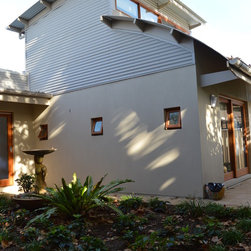
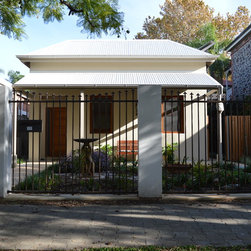
A study of solar angles revealed that high level clerestory type windows within skillion roofs would be required to capture winter sunlight. The design form of skillion roofs with clerestory windows at roof level was not in harmony with the heritage aesthetic requested by council, therefore a two metre strip of building emulating the single fronted cottage, not unlike a movie set, was constructed at the street-front, screening the modern building behind.
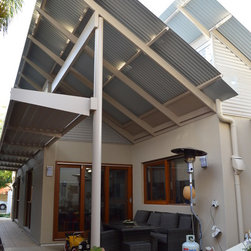
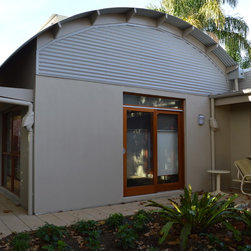
Due to the long narrow block, the built form is a series of 3 linked pavilions with useable courtyards between.
The walling is reverse brick veneer – insulated cladding on the outer leafs of the external cavity walls, and brickwork for the internal leaf and all internal walls. This provides the thermal mass required to minimise internal temperature fluctuations, and with the insulation R value in the external walls of R5.5 and LowE glazing throughout, temperatures are maintained internally at comfort levels. During the January 2014 heatwave of 5 days above 40 degrees, internal temperatures were maintained at 22 degrees.
Dual Concepts
strong visual dualities exist at a number of levels.
Cultural
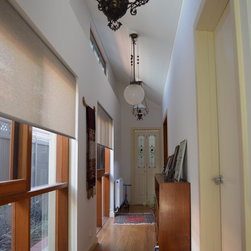
The Owners have different national cultural backgrounds which has created strong “blend” of South East Asian and contemporary Australian influences, sometimes with surprising results. An example exists when upon entering the house via the single fronted traditional Porch, one is confronted with the modern-day angular ceiling which further is adorned with traditional Indonesian metal pendant lights.
Heritage
Once past the Heritage street commitment, one is immediately confronted by the new contemporary special arrangements with its flood of natural light.
Passive Energy Demands
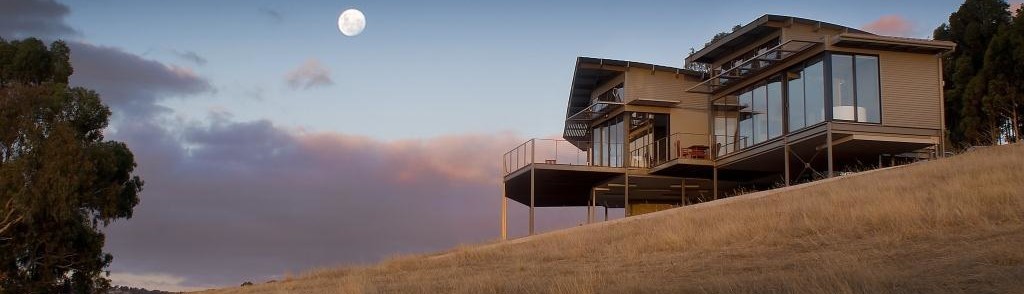
The plan form of the house is three distinct pavilions. Each of the pavilions serves a different domestic purpose, - Living/Study-workspace/Sleeping. These have different energy and comfort demands, which in a passive house creates different construct demands. Thus the three pavilions have three distinctly different visual appearances.
The basic principles of passive house comfort and energy generation have been applied, consisting of
• Orientation of all rooms to the north
• Zoning of areas of different energy demands
• High levels of insulation in external walls and roof
• Good thermal mass located internally and excluded from the external skin
• Highly performing glazing in timber frames
• Clerestory windows to allow solar penetration to the central/southern portions of the rooms.
• Location of Utility spaces (Garage) on the western façade.
• Roof well positioned for photovoltaic panel solar access year round.
A study of solar angles revealed that high level clerestory type windows within skillion roofs would be required to capture winter sunlight. The design form of skillion roofs with clerestory windows at roof level was not in harmony with the heritage aesthetic requested by council, therefore a two metre strip of building emulating the single fronted cottage, not unlike a movie set, was constructed at the street-front, screening the modern building behind.
Due to the long narrow block, the built form is a series of 3 linked pavilions with useable courtyards between.
The walling is reverse brick veneer – insulated cladding on the outer leafs of the external cavity walls, and brickwork for the internal leaf and all internal walls. This provides the thermal mass required to minimise internal temperature fluctuations, and with the insulation R value in the external walls of R5.5 and LowE glazing throughout, temperatures are maintained internally at comfort levels. During the January 2014 heatwave of 5 days above 40 degrees, internal temperatures were maintained at 22 degrees.
Dual Concepts
strong visual dualities exist at a number of levels.
Cultural
The Owners have different national cultural backgrounds which has created strong “blend” of South East Asian and contemporary Australian influences, sometimes with surprising results. An example exists when upon entering the house via the single fronted traditional Porch, one is confronted with the modern-day angular ceiling which further is adorned with traditional Indonesian metal pendant lights.
Heritage
Once past the Heritage street commitment, one is immediately confronted by the new contemporary special arrangements with its flood of natural light.
Passive Energy Demands
The plan form of the house is three distinct pavilions. Each of the pavilions serves a different domestic purpose, - Living/Study-workspace/Sleeping. These have different energy and comfort demands, which in a passive house creates different construct demands. Thus the three pavilions have three distinctly different visual appearances.
The basic principles of passive house comfort and energy generation have been applied, consisting of
• Orientation of all rooms to the north
• Zoning of areas of different energy demands
• High levels of insulation in external walls and roof
• Good thermal mass located internally and excluded from the external skin
• Highly performing glazing in timber frames
• Clerestory windows to allow solar penetration to the central/southern portions of the rooms.
• Location of Utility spaces (Garage) on the western façade.
• Roof well positioned for photovoltaic panel solar access year round.
Project Cost: $200,001 AUD - $500,000 AUD
Country: Australia
Postcode: 5061