
Beach House
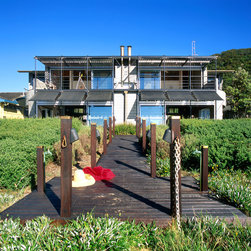
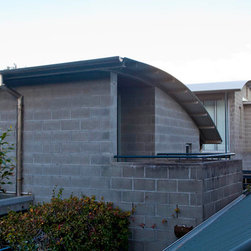
Overlooking Broken Bay, these two beach houses, the mirror image of each other, are modest in comparison to many contemporary homes. Designed for two families with young children, both homes are idyllically located on the edge of the beach. Built in the mid-1990s, the concrete block homes have a fairly discrete presence to the street.
The ground level, facing the street, is occupied by garages. There’s also a side path that leads to each entrance. In keeping with the brief, Andre Porebski located the children’s wing closest to the street. Comprising a living area and adjacent bathroom, this wing includes a mezzanine style bedroom accessed by a ladder. To the beach side the main living areas and kitchen are located to maximize the views and access to the beach.
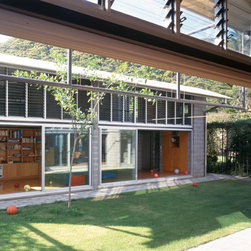
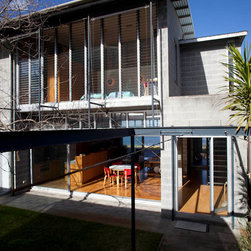
One of the main features of the Pearl Beach house is the shared internal courtyard, separating the children’s wing from an open plan kitchen, living and dining area. As it can get extremely windy here, particularly after midday, we wanted to make sure there was a protected outdoor area that could be used throughout the winter months. The courtyard also assists with cross-ventilation, there are large sliding doors either side of the living spaces, together with highlight glass louvred windows.
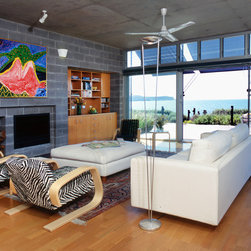
Through the openness of the building, with large glass doors at both ends of the family room, and on the east side of the kids room, there is a strong connection to the beach. This openness also allows for views from the courtyard.
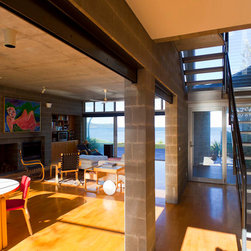
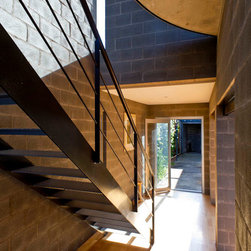
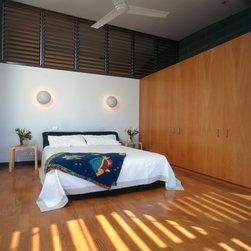
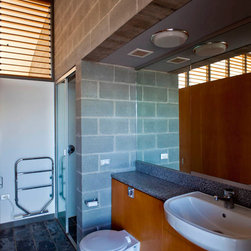
Like the exterior, which is fairly robust, the interior finishes include exposed concrete block walls and blackbutt joinery in the kitchen. Timber features extensively on the floors. “Our clients wanted their houses to be low maintenance. They didn’t want to be concerned if sand was brought into the house,” says Porebski, who also included a large timber deck orientated to the water.
The scale of these homes is appropriate to this quiet enclave by the beach. To reduce the building’s impact a curved steel roof, tapering on either side is used – the house becomes an extension of the slope of the beach.
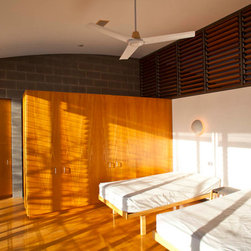
To reflect the ‘beach house’ feel of an easy going house, the materials selected were simple. The walls are face concrete block throughout (with only plasterboard stud walls separating the two bedrooms upstairs). Ceilings are off-form concrete and the floors timber. The exterior uses shade devices that can be retracted to protect form the sun and provide a façade that can ‘move’.
The ground level, facing the street, is occupied by garages. There’s also a side path that leads to each entrance. In keeping with the brief, Andre Porebski located the children’s wing closest to the street. Comprising a living area and adjacent bathroom, this wing includes a mezzanine style bedroom accessed by a ladder. To the beach side the main living areas and kitchen are located to maximize the views and access to the beach.
One of the main features of the Pearl Beach house is the shared internal courtyard, separating the children’s wing from an open plan kitchen, living and dining area. As it can get extremely windy here, particularly after midday, we wanted to make sure there was a protected outdoor area that could be used throughout the winter months. The courtyard also assists with cross-ventilation, there are large sliding doors either side of the living spaces, together with highlight glass louvred windows.
Through the openness of the building, with large glass doors at both ends of the family room, and on the east side of the kids room, there is a strong connection to the beach. This openness also allows for views from the courtyard.
Like the exterior, which is fairly robust, the interior finishes include exposed concrete block walls and blackbutt joinery in the kitchen. Timber features extensively on the floors. “Our clients wanted their houses to be low maintenance. They didn’t want to be concerned if sand was brought into the house,” says Porebski, who also included a large timber deck orientated to the water.
The scale of these homes is appropriate to this quiet enclave by the beach. To reduce the building’s impact a curved steel roof, tapering on either side is used – the house becomes an extension of the slope of the beach.
To reflect the ‘beach house’ feel of an easy going house, the materials selected were simple. The walls are face concrete block throughout (with only plasterboard stud walls separating the two bedrooms upstairs). Ceilings are off-form concrete and the floors timber. The exterior uses shade devices that can be retracted to protect form the sun and provide a façade that can ‘move’.
Project Year: Pre-2005
Country: Australia