
Beach House 2
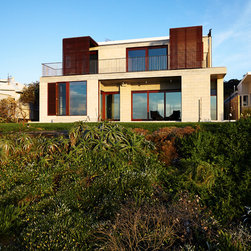
The Block House is located on the shore of Pearl Beach, a secluded coastal community north of Sydney, Australia. Pearl Beach is formed by two coastal headlands, defined by eucalypt bush to the north and south and a rainforest to the west.
Here the bush meets the coastline, a windswept place where the surf washes the shoreline, changing the contours throughout the day. The Block House is a bridge point between the two, affording a secluded escape that both defends and embraces its surroundings.
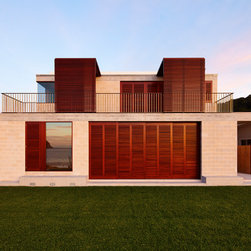
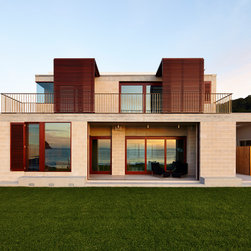
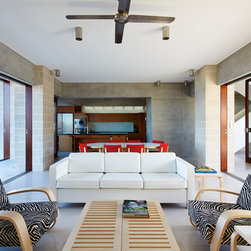
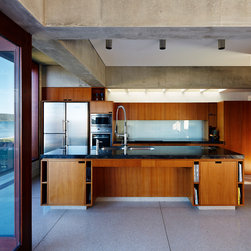
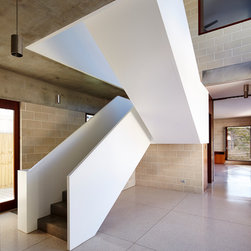
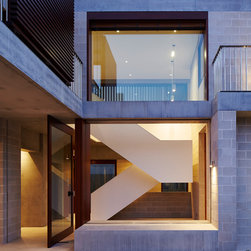
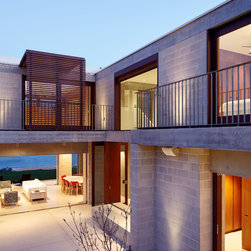
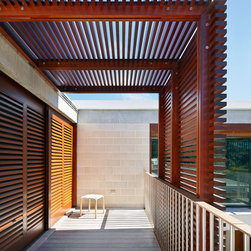
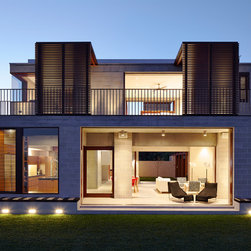
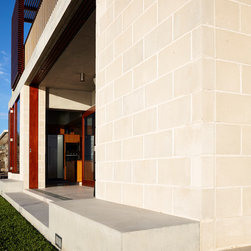
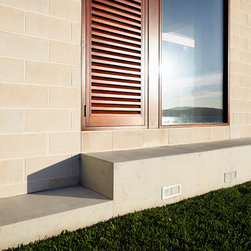
The raw qualities of robust and heavy elements pay homage to the cliffs and caves of the surrounding headlands and together with the heavy breaking waves upon the beach have influenced the form and materiality of the building. A simple palette of materials and finishes, executed with finely detailed precision and requiring minimal maintenance, create the light sensibility of the structure. Operable layers of the facade generate the transparency of the house, where primary visual and physical connections are made to the surrounding natural site features. Sliding timber shutters and cavity sliding windows and doors allow spaces to open seamlessly, blurring the demarcation between inside and out.
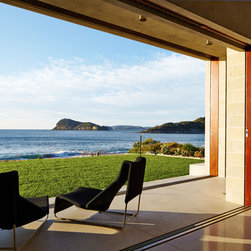
The client brief asked for a private sanctuary to escape their city home. Aside from capturing the beach and ocean views, the house needed to afford protection against the coastal environment including the daily onshore winds, sand and salt spray and at the same time be low-key and low maintenance; the sort of place you can walk bare-foot throughout the entire year. It achieves this via an open plan, with free-flowing spaces from inside to out, allowing summer and winter solar access within a protective barrier to the on-shore winds.
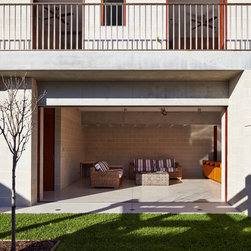
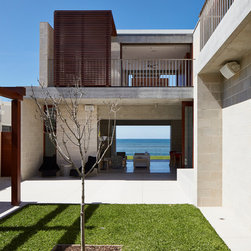
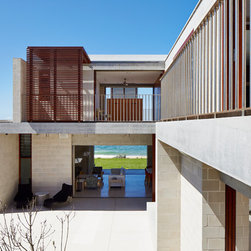
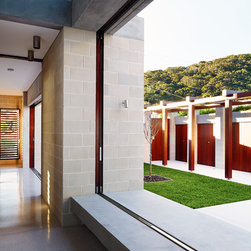
To address the brief an L-shaped plan was conceptualised. This takes the form of two wings around an internal north-facing courtyard, which becomes an enclosure against the sometimes harsh elements. The courtyard not only becomes a private sanctuary that engages with the beach and the bush behind, but is also a necessary space for a beach house in this location.
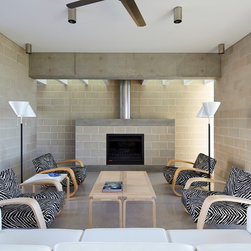
As a beach house it only has the rooms that are required. A living space and media room that flows to the courtyard, a sewing room, 3 bedrooms and a garage for cars, a boat and plant rooms. Each room is used on a daily basis and has its own means of duty.
Controlled and consistent sun access and ventilation throughout the house is provided, whilst the single-room courtyard planning allows movement between interior and exterior spaces to remain unobstructed.
The house can be closed to the prevailing winds when necessary, or opened to clement sea breezes and vistas on milder days. When the onshore wind is up, the courtyard gives protection from afternoon western sun and is the perfect place for long, lazy lunches.
The Block House addresses the need for sustainability head-on, with passive cooling and heating via protective external timber shutters, sub-floor ventilation, and direct sea-water geothermal regulation. This allows a constant annual floor temperature of between 16-18 degrees Celcius.
Consumption is tempered by rainwater harvesting, solar panels, sub-floor wind ventilation and thoughtfully placed skylights. The operable timber shutters and low-e double glazing provide protection from fluctuating external conditions, and work in unison with thermally massed materials to deal with high diurnal temperature ranges.
The outcome is a thoughtful sequence of meticulously crafted spaces forming a house that celebrates the act of living on the beach.
Here the bush meets the coastline, a windswept place where the surf washes the shoreline, changing the contours throughout the day. The Block House is a bridge point between the two, affording a secluded escape that both defends and embraces its surroundings.
The raw qualities of robust and heavy elements pay homage to the cliffs and caves of the surrounding headlands and together with the heavy breaking waves upon the beach have influenced the form and materiality of the building. A simple palette of materials and finishes, executed with finely detailed precision and requiring minimal maintenance, create the light sensibility of the structure. Operable layers of the facade generate the transparency of the house, where primary visual and physical connections are made to the surrounding natural site features. Sliding timber shutters and cavity sliding windows and doors allow spaces to open seamlessly, blurring the demarcation between inside and out.
The client brief asked for a private sanctuary to escape their city home. Aside from capturing the beach and ocean views, the house needed to afford protection against the coastal environment including the daily onshore winds, sand and salt spray and at the same time be low-key and low maintenance; the sort of place you can walk bare-foot throughout the entire year. It achieves this via an open plan, with free-flowing spaces from inside to out, allowing summer and winter solar access within a protective barrier to the on-shore winds.
To address the brief an L-shaped plan was conceptualised. This takes the form of two wings around an internal north-facing courtyard, which becomes an enclosure against the sometimes harsh elements. The courtyard not only becomes a private sanctuary that engages with the beach and the bush behind, but is also a necessary space for a beach house in this location.
As a beach house it only has the rooms that are required. A living space and media room that flows to the courtyard, a sewing room, 3 bedrooms and a garage for cars, a boat and plant rooms. Each room is used on a daily basis and has its own means of duty.
Controlled and consistent sun access and ventilation throughout the house is provided, whilst the single-room courtyard planning allows movement between interior and exterior spaces to remain unobstructed.
The house can be closed to the prevailing winds when necessary, or opened to clement sea breezes and vistas on milder days. When the onshore wind is up, the courtyard gives protection from afternoon western sun and is the perfect place for long, lazy lunches.
The Block House addresses the need for sustainability head-on, with passive cooling and heating via protective external timber shutters, sub-floor ventilation, and direct sea-water geothermal regulation. This allows a constant annual floor temperature of between 16-18 degrees Celcius.
Consumption is tempered by rainwater harvesting, solar panels, sub-floor wind ventilation and thoughtfully placed skylights. The operable timber shutters and low-e double glazing provide protection from fluctuating external conditions, and work in unison with thermally massed materials to deal with high diurnal temperature ranges.
The outcome is a thoughtful sequence of meticulously crafted spaces forming a house that celebrates the act of living on the beach.
Project Year: 2013
Country: Australia
Postcode: 2256