

How to Choose the Best AI Landscape Design Tool in 2026 (What Actually Matters)
If you are searching for the best AI landscape design tool, you are probably trying to solve a very ordinary problem: your outdoor space is real, your budget is real, and your family cannot agree on what “better” looks like. The internet offers endless inspiration. What it rarely offers is alignment on your actual constraints—your fence line, your slope, your mature trees, your climate, and the maintenance you will tolerate.
In 2026, the landscape AI category has matured enough to be useful, but also noisy enough to waste your time. The “best” tool is not the one with the flashiest render. It is the one that helps you make earlier, cheaper decisions while staying grounded in site truth.
Below is a buyer’s guide framework—what actually matters—followed by how to apply it without fooling yourself.
1) It must start from your site, not from a mood board
The most common failure mode is beautiful irrelevance: a concept that looks premium while ignoring the property you own. A strong landscape AI workflow should be photo-grounded or equivalently honest about what it is optimizing.
Ask: Does the tool force you to encode context—house relationship, boundaries, existing paving, key trees—so outputs resemble your yard? If the workflow behaves like “type a vibe, get a fantasy,” you will get pretty pictures that collapse the moment a contractor asks practical questions.
2) Location and climate should be optional—but serious tools take them seriously
“Best AI landscape design” is not about exotic plants that die in your winters. Ask whether the product can incorporate location context as a realism lever: a bias toward more believable planting palettes and materials for your region.
Hold the right expectation: location-aware prompting is not a substitute for nursery inventory checks, invasive-species diligence, or a local designer’s judgment. It is a way to reduce climate fantasy before you fall in love with the wrong direction.
3) Labels can help communication—if framed as reference, not authority
Some high-quality outputs may include on-image plant callouts. That can be valuable because it turns aesthetics into a conversation: substitutions, spacing, mature size, water needs.
4) Iteration should be structured, not endless resets
Outdoor design is layered: hardscape logic, planting structure, detailing. The best AI landscape workflows support fine-tuning—adjust materials, planting emphasis, and common outdoor amenities—plus custom instructions for the one change that must land without throwing away the whole concept.
If every tweak feels like starting over, your tool is optimizing for screenshots, not projects.
5) Scale honesty: home lots are not campuses
The best AI landscape design tool for a backyard refresh may be the wrong tool for a streetscape, campus, or commercial site—and vice versa. Credibility signals include a clear split between residential yard visualization and large-scale landscape workflows.
If a product claims one interface solves every outdoor problem on earth, you are usually getting generic outputs and mismatched briefs.
Putting the checklist to work: what we recommend you try
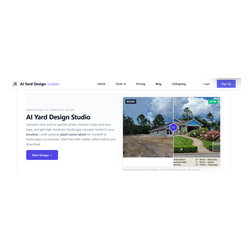
If you want a concrete example of a platform built around these principles—photo-grounded generation, zone-aware direction, optional location context, staged quality tiers with transparent credit use, plant callouts positioned as reference, structured refinement, and a separate lane for large-scale sites—open ai-yard-design.com and run your first exploration on a truthful yard photo.
Start with a contextual image, choose the outdoor zone that matches your job, write constraints like a brief (not like vibes), and iterate in layers. If your project is not a home lot, use the platform’s large-scale landscape path so your brief matches the scale of what you are designing.
Conclusion: “best” is contextual, but the criteria are not
The best AI landscape design tool in 2026 is the one that helps you agree earlier—on your photo, your priorities, and your stage of decision—while staying honest about what AI can and cannot do. Choose for site grounding, zone clarity, staged quality, climate realism, safe labeling, structured iteration, and scale fit.
Do that, and you will spend less money buying the same lesson twice: once as confusion, and again as rework.
In 2026, the landscape AI category has matured enough to be useful, but also noisy enough to waste your time. The “best” tool is not the one with the flashiest render. It is the one that helps you make earlier, cheaper decisions while staying grounded in site truth.
Below is a buyer’s guide framework—what actually matters—followed by how to apply it without fooling yourself.
1) It must start from your site, not from a mood board
The most common failure mode is beautiful irrelevance: a concept that looks premium while ignoring the property you own. A strong landscape AI workflow should be photo-grounded or equivalently honest about what it is optimizing.
Ask: Does the tool force you to encode context—house relationship, boundaries, existing paving, key trees—so outputs resemble your yard? If the workflow behaves like “type a vibe, get a fantasy,” you will get pretty pictures that collapse the moment a contractor asks practical questions.
2) Location and climate should be optional—but serious tools take them seriously
“Best AI landscape design” is not about exotic plants that die in your winters. Ask whether the product can incorporate location context as a realism lever: a bias toward more believable planting palettes and materials for your region.
Hold the right expectation: location-aware prompting is not a substitute for nursery inventory checks, invasive-species diligence, or a local designer’s judgment. It is a way to reduce climate fantasy before you fall in love with the wrong direction.
3) Labels can help communication—if framed as reference, not authority
Some high-quality outputs may include on-image plant callouts. That can be valuable because it turns aesthetics into a conversation: substitutions, spacing, mature size, water needs.
4) Iteration should be structured, not endless resets
Outdoor design is layered: hardscape logic, planting structure, detailing. The best AI landscape workflows support fine-tuning—adjust materials, planting emphasis, and common outdoor amenities—plus custom instructions for the one change that must land without throwing away the whole concept.
If every tweak feels like starting over, your tool is optimizing for screenshots, not projects.
5) Scale honesty: home lots are not campuses
The best AI landscape design tool for a backyard refresh may be the wrong tool for a streetscape, campus, or commercial site—and vice versa. Credibility signals include a clear split between residential yard visualization and large-scale landscape workflows.
If a product claims one interface solves every outdoor problem on earth, you are usually getting generic outputs and mismatched briefs.
Putting the checklist to work: what we recommend you try
If you want a concrete example of a platform built around these principles—photo-grounded generation, zone-aware direction, optional location context, staged quality tiers with transparent credit use, plant callouts positioned as reference, structured refinement, and a separate lane for large-scale sites—open ai-yard-design.com and run your first exploration on a truthful yard photo.
Start with a contextual image, choose the outdoor zone that matches your job, write constraints like a brief (not like vibes), and iterate in layers. If your project is not a home lot, use the platform’s large-scale landscape path so your brief matches the scale of what you are designing.
Conclusion: “best” is contextual, but the criteria are not
The best AI landscape design tool in 2026 is the one that helps you agree earlier—on your photo, your priorities, and your stage of decision—while staying honest about what AI can and cannot do. Choose for site grounding, zone clarity, staged quality, climate realism, safe labeling, structured iteration, and scale fit.
Do that, and you will spend less money buying the same lesson twice: once as confusion, and again as rework.