
Small Eat-in Kitchen Design Ideas
Refine by:
Budget
Sort by:Popular Today
1 - 20 of 7,483 photos
Item 1 of 3
 4305design
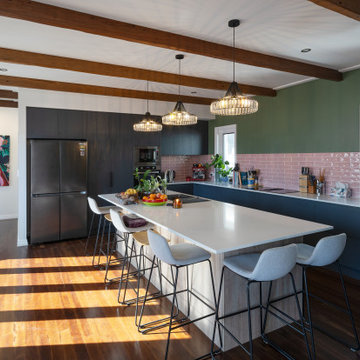
Small eclectic l-shaped eat-in kitchen in Brisbane with black cabinets, pink splashback, subway tile splashback, dark hardwood floors, with island, brown floor, white benchtop and exposed beam.
 Mihaly Slocombe
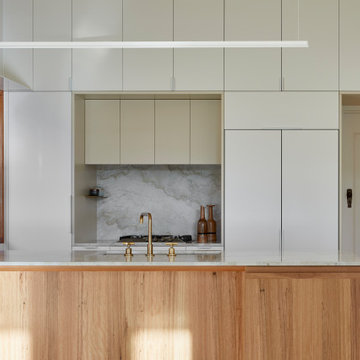
Coburg Frieze is a purified design that questions what’s really needed.
The interwar property was transformed into a long-term family home that celebrates lifestyle and connection to the owners’ much-loved garden. Prioritising quality over quantity, the crafted extension adds just 25sqm of meticulously considered space to our clients’ home, honouring Dieter Rams’ enduring philosophy of “less, but better”.
We reprogrammed the original floorplan to marry each room with its best functional match – allowing an enhanced flow of the home, while liberating budget for the extension’s shared spaces. Though modestly proportioned, the new communal areas are smoothly functional, rich in materiality, and tailored to our clients’ passions. Shielding the house’s rear from harsh western sun, a covered deck creates a protected threshold space to encourage outdoor play and interaction with the garden.
This charming home is big on the little things; creating considered spaces that have a positive effect on daily life.
 Perrie Designs
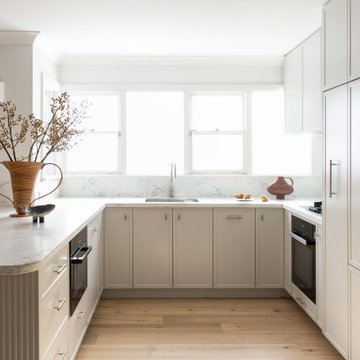
Reimagined kitchen design at Perrie Designs Mosman House IV Project transformed this kitchen from being closed off to being open and functional.
Design ideas for a small transitional u-shaped eat-in kitchen in Sydney.
Design ideas for a small transitional u-shaped eat-in kitchen in Sydney.
 Urban Habitats
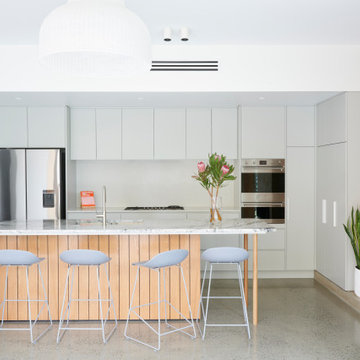
Design ideas for a small contemporary galley eat-in kitchen in Adelaide with a drop-in sink, marble benchtops, white splashback, stone slab splashback, stainless steel appliances, concrete floors, with island, grey floor and grey benchtop.
 hetre.amenagement
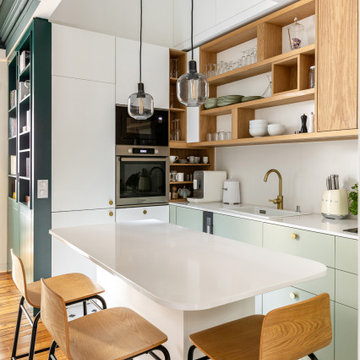
Cuisine sur mesure avec ilôt
Inspiration for a small scandinavian u-shaped eat-in kitchen in Paris with a single-bowl sink, beaded inset cabinets, green cabinets, quartzite benchtops, white splashback, ceramic splashback, panelled appliances, light hardwood floors, with island, beige floor and white benchtop.
Inspiration for a small scandinavian u-shaped eat-in kitchen in Paris with a single-bowl sink, beaded inset cabinets, green cabinets, quartzite benchtops, white splashback, ceramic splashback, panelled appliances, light hardwood floors, with island, beige floor and white benchtop.
 Lydia Allen Interiors
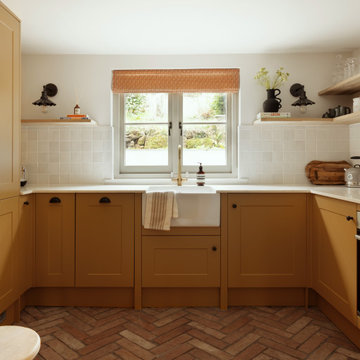
Design ideas for a small eclectic u-shaped eat-in kitchen in Cornwall with a farmhouse sink, shaker cabinets, yellow cabinets, quartzite benchtops, white splashback, ceramic splashback, stainless steel appliances, terra-cotta floors, no island, brown floor and white benchtop.
 Kitty Lee Architecture
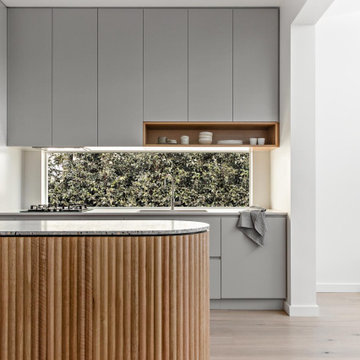
This is an example of a small contemporary galley eat-in kitchen in Sydney with a double-bowl sink, grey cabinets, terrazzo benchtops, black appliances, light hardwood floors, with island and grey benchtop.
 LAURA LAKIN DESIGN
Photography by Juliet Murphy
www.julietmurphyphotography.com
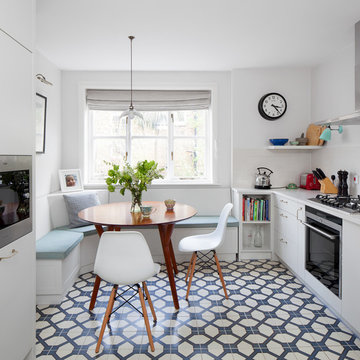
This is an example of a small contemporary galley eat-in kitchen in London with flat-panel cabinets, white cabinets, ceramic floors and no island.
This is an example of a small contemporary galley eat-in kitchen in London with flat-panel cabinets, white cabinets, ceramic floors and no island.
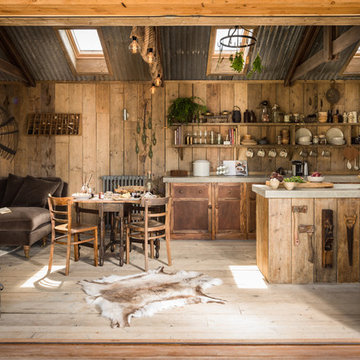
Design ideas for a small country galley eat-in kitchen in Cornwall with a farmhouse sink, beaded inset cabinets, medium wood cabinets, panelled appliances, light hardwood floors and concrete benchtops.
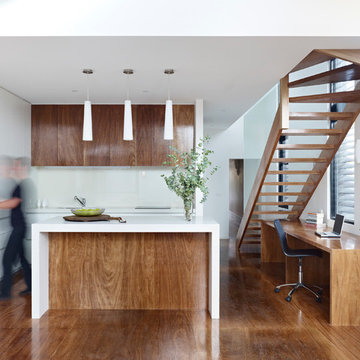
 Nic Owen Architects
Photo of a small modern galley eat-in kitchen in Melbourne with an undermount sink, flat-panel cabinets, medium wood cabinets, quartz benchtops, white splashback, glass sheet splashback, panelled appliances, medium hardwood floors and with island.
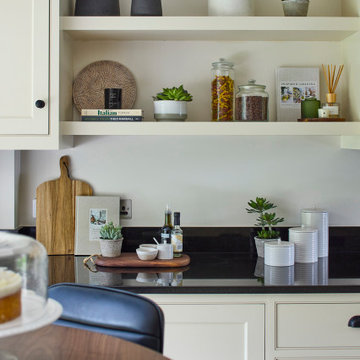
 NB Interiors UK
Photo of a small traditional galley eat-in kitchen in Other with shaker cabinets, beige cabinets, quartz benchtops, porcelain floors, with island and white benchtop.
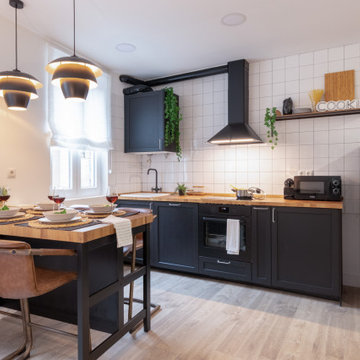
 ENFOCASA
Inspiration for a small contemporary single-wall eat-in kitchen in Other with a drop-in sink, shaker cabinets, black cabinets, wood benchtops, white splashback, porcelain splashback, black appliances, grey floor and beige benchtop.
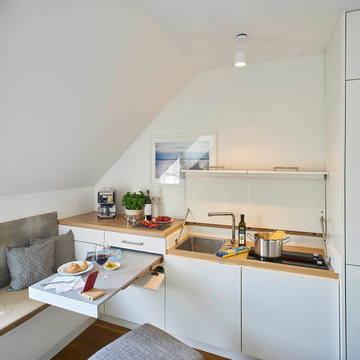
 Ute Günther wachgeküsst INNENARCHITEKTUR+DESIGN
This is an example of a small contemporary single-wall eat-in kitchen in Stuttgart with flat-panel cabinets, white cabinets, laminate benchtops, white splashback, panelled appliances, medium hardwood floors, beige benchtop, an undermount sink and brown floor.
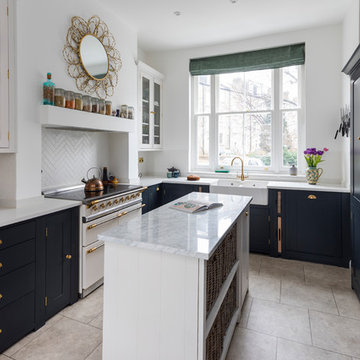
 Paul Turner
Neptune Black ( Charcoal) shaker ( suffolk range) kitchen with brass handles and knobs .
supplied by woods of london
photo's by Chris Snook
Photo of a small transitional l-shaped eat-in kitchen in London with a farmhouse sink, shaker cabinets, black cabinets, quartzite benchtops, limestone floors, with island, beige floor, white splashback and white appliances.
Photo of a small transitional l-shaped eat-in kitchen in London with a farmhouse sink, shaker cabinets, black cabinets, quartzite benchtops, limestone floors, with island, beige floor, white splashback and white appliances.
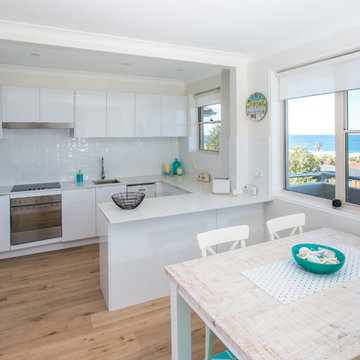
 JMR Building Contractors Pty Ltd
Jarrad Duffy Photography
Photo of a small beach style u-shaped eat-in kitchen in Sydney with a drop-in sink, flat-panel cabinets, white cabinets, quartz benchtops, white splashback, subway tile splashback, stainless steel appliances, light hardwood floors and no island.
Photo of a small beach style u-shaped eat-in kitchen in Sydney with a drop-in sink, flat-panel cabinets, white cabinets, quartz benchtops, white splashback, subway tile splashback, stainless steel appliances, light hardwood floors and no island.
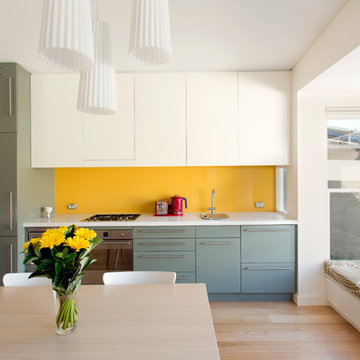
 Danny Broe Architect
Photography: Karina Illovska
The kitchen is divided into different colours to reduce its bulk and a surprise pink study inside it has its own little window. The front rooms were renovated to their former glory with replica plaster reinstated. A tasmanian Oak floor with a beautiful matt water based finish was selected by jess and its light and airy. this unifies the old and new parts. Colour was used playfully. Jess came up with a diverse colour scheme that somehow works really well. The wallpaper in the hall is warm and luxurious.
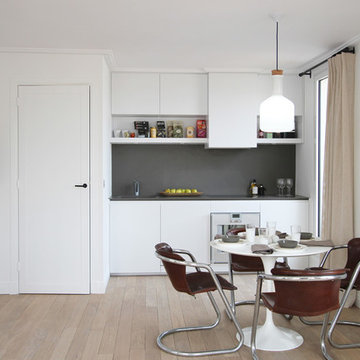
 Kasha Paris
Completely renovated 1 bedroom apartment, in the heart of the St germain des Pres neighborhood in Paris.
This is an example of a small modern single-wall eat-in kitchen in Paris with flat-panel cabinets, white cabinets, grey splashback and no island.
This is an example of a small modern single-wall eat-in kitchen in Paris with flat-panel cabinets, white cabinets, grey splashback and no island.
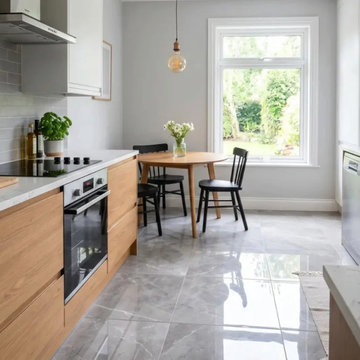
 Tiles Paradise UK
The right kitchen tiles can make a compact kitchen feel noticeably larger than it actually is. Size, finish, and layout each shape how open a room reads, and getting that combination right turns a cramped cooking area into one that feels calm and uncluttered. The decisions below — from light reflectance to grout colour to tile format — are the ones that quietly determine how spacious a small kitchen looks and how well it holds up to daily use.
Light Reflectance In Wall Tiles
How a surface handles light has a direct effect on perceived space. Glossy finishes bounce daylight across the room and brighten the corners that compact kitchens tend to leave dark, which is why brilliant white kitchen tiles lift ambient brightness so quickly. Matte finishes do the opposite — they absorb light and can make a tight space feel slightly more enclosed.
Reflective wall tiles amplify whatever natural light is already available, often without the need for extra fixtures. Cream tones add warmth while keeping luminosity high, and high-gloss surfaces push brightness even further. A luminous room almost always reads as larger than a dark, light-absorbing one, so designers frequently lean on reflective finishes to stretch a small footprint.
Grout Colour And Floor Continuity
Visible grout lines create a grid that stops the eye and draws attention to tight dimensions. Matching grout colour to the tile surface removes those interruptions, and the seamless effect works especially well with natural beige tones. Narrow joints help too, which is why rectified, precision-cut edges suit small spaces — they allow ultra-thin grout lines and a more continuous surface.
High-contrast grout introduces visual busyness that compact rooms can't afford. Colour-matched epoxy keeps joints clean and durable while preserving that unbroken plane. The result is a near-monolithic floor that the eye reads as a single expanse rather than a patchwork of small units.
Large-Format Tiles In Compact Spaces
It runs counter to intuition, but oversized formats often perform best in the smallest rooms. Fewer joints mean less visual clutter, and a 60x120cm tile laid horizontally stretches the perceived width of a tight galley layout. Large slabs reduce the intersections that chop up kitchen floor tiles, drawing the eye outward toward the edges of the room.
Replacing small square tiles with larger porcelain slabs also modernises the overall feel and creates a calmer, more continuous base. For most compact kitchens, that uninterrupted surface area does more for the sense of space than a busier small-format floor ever would.
Layout And Orientation
Pattern direction changes how a wall reads. Vertical stacking draws the eye upward and lifts perceived ceiling height, useful in rooms that feel boxed in. Horizontal stacking does the reverse, visually widening narrow walls — a run of deep blue kitchen tiles laid horizontally adds depth without closing the space in.
Classic brick-bond and metro layouts offer timeless appeal but need careful orientation to suit the room. Herringbone introduces movement and draws attention away from a limited floor area, though the zigzag demands proportional planning so it doesn't overwhelm a small space.
Colour And Pattern Strategy
Busy patterns can swamp a small room if they're used everywhere. A single feature zone solves this: confining patterned kitchen tiles to one backsplash area adds character without tipping into visual chaos. Elsewhere, a monochrome palette keeps the room unified, and tone-on-tone schemes — subtle grey kitchen tiles, for instance — create a sophisticated backdrop for modern appliances.
Deliberate contrast can still define zones intelligently. Pairing black kitchen tiles on base units with lighter walls above grounds the room and creates a gentle gradient, which tends to flatter a compact layout more than a single flat colour throughout.
Porcelain Vs Ceramic Durability
Material density drives longevity in a high-traffic cooking zone. Porcelain kitchen tiles are vitrified, giving them superior water resistance and structural integrity, and they stand up to decades of heavy daily use. Ceramic kitchen tiles are lighter, which makes them well suited to walls and splashbacks where reduced weight helps installation and allows more intricate detailing.
Maintenance differs between the two clay-based materials. Non-porous porcelain is the safer choice for busy households and floors that see spills and moisture, where absolute water resistance matters most.
Polished Onyx-Effect Tiles For Splashbacks
Polished surfaces replicate the luxury of natural stone without the upkeep stone demands, and an onyx-effect finish brings a high-end look to a modern kitchen. The reflective glaze bounces task lighting across prep areas attractively.
The trade-off is that glossy finishes show watermarks more readily than matte ones, so they reward regular wiping. Set against that, strong heat resistance makes them a sensible option for stove-adjacent areas where the surface takes direct warmth.
Wood-Effect Porcelain For Open-Plan Kitchens
Wood-effect porcelain pairs timber aesthetics with the thermal conductivity needed for underfloor heating — it retains and radiates warmth far more effectively than real timber. Plank formats also elongate a room when laid parallel to the longest wall.
Many of these tiles convincingly mimic Scandinavian oak or richer walnut tones, delivering durability, warmth underfoot, and a visual stretch all at once. For open-plan layouts with heating beneath the floor, it's one of the more practical premium choices available.
Backsplash Decisions
A splashback is prime real estate for a design statement, and reflective surfaces add depth right at eye level. Veined options like marble-effect tiles bring organic movement to otherwise rigid cabinetry, and matching the splashback to countertop materials creates a cohesive, considered finish.
Grout maintenance matters most behind hobs and sinks, where stain-resistant epoxy keeps surfaces hygienic and easy to clean over the long term.
High-performance splashbacks generally share three properties:
- High thermal shock resistance against direct stove heat
- Zero porosity, to repel cooking oils and heavy moisture
- Clean integration with the surrounding wall tiles
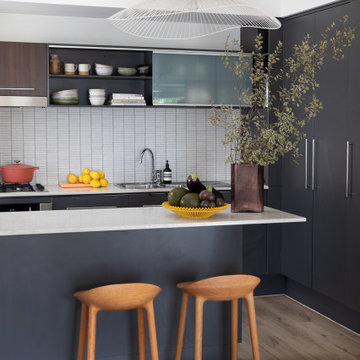
 Studio Lifestyling
This tired apartment was in desperate need of a refresh, and Studio Lifestyling gave it a complete makeover. From new paint and hybrid timber floors to a modern kitchen update, we turned this space into a stylish, comfortable oasis.
We handpicked furniture, rugs, cushions, lighting, and art to create a cohesive look that feels inviting and relaxed. Our aim was to make every part of the apartment not just beautiful, but practical and easy to live in.
The end result is an apartment that’s both stylish and welcoming, offering a peaceful retreat in the heart of the city.
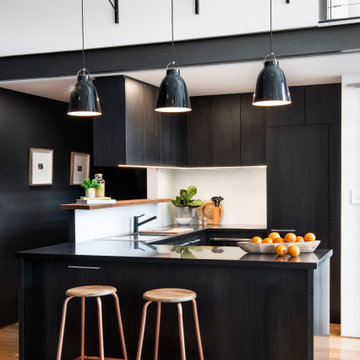
 McGarry Constructions Pty Limited
Inspiration for a small industrial u-shaped eat-in kitchen in Sydney with a drop-in sink, white splashback, glass sheet splashback, black appliances, medium hardwood floors, a peninsula and black benchtop.
1