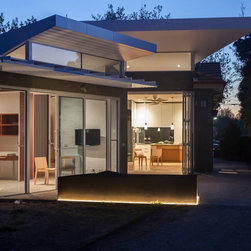


Two-Peaks House
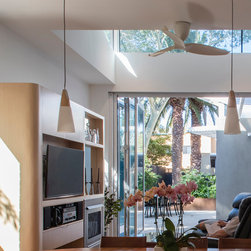
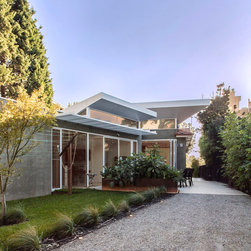
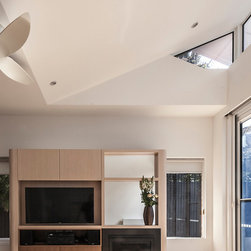
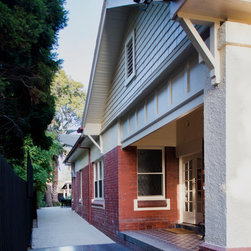
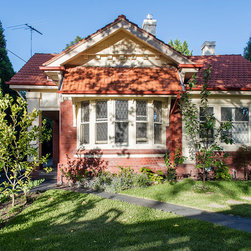
The most radical elements of Two Peaks house are the pop-up roof forms; raking-triangular-jutting-out “peaks”; designed to protect from summer sun, allow winter sun, dramatically improve daylight quality and thermal efficiency thourgh ceiling fans, hydronic heating and cross-ventilation. The thermal mass effect of the original plastered brick walls of the Edwardian house, and of the reverse brick-veneer-exposed-slab of the “writer’s” studio, is optimised. The white modern lines of a contemporary expression of pergola acts as sun shading for lower-tier windows, and the vertical white screen dividing the courtyard, though a parallax action - allows light but not views through.
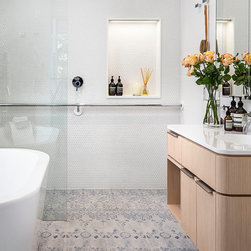
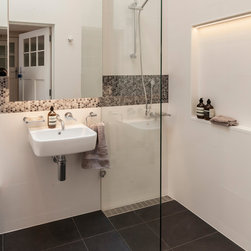
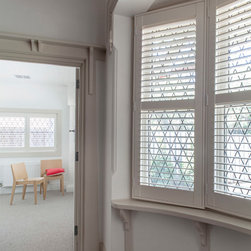
Clever thinking extends down to the scales of cost and detail. The retired clients had fundamental brief elements of restricted budget, small environmental footprint, accommodating family as well as future live-in carers, health challenges including poor eyesight and mobility– and wanted to retain a lyrical connection with garden and palm trees. These brief requirements were accommodated through the use of orientation, wide doorways, flush thresholds, discreet handrails in shower recesses and as shower rails, and a raised rear terrace to provide step-free accessibility. By reducing the footprint of the main house - reusing leadlight windows, light fittings and ALL old bricks for use in the reverse brick veneer studio –together with efficient landscaping strategies, the whole site was renovated within budget.
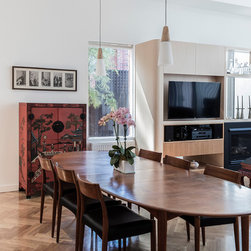
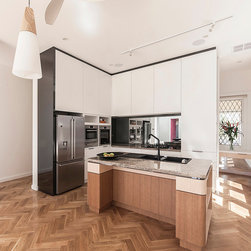
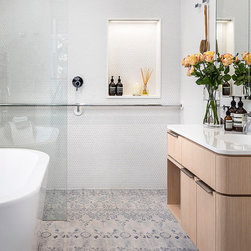
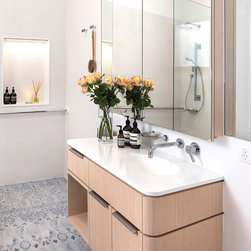
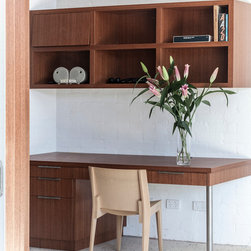
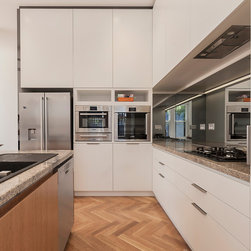
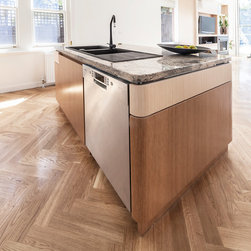
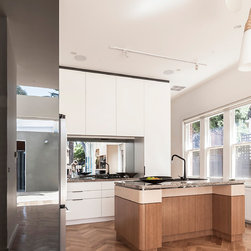
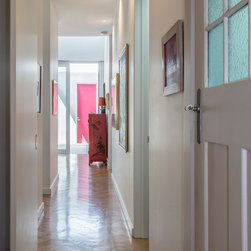
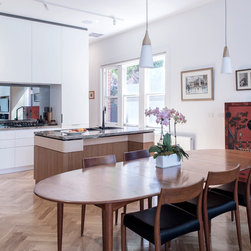
The design is remarkable for its beautiful sensitivities and rigorous detailing. The writer’s studio explores rich hues of timber-veneer referencing Australian classical modernism, and complementing textures of painted brick, concrete slab, undyed wool carpet and high level windows. In the house, the oak parquetry together with unique ensuite tiles creates a richly textured floor, offset by the kitchen of white cabinets doors, mirror black rimex end panels and mirror splashback. Three unique rounded-corner joinery pieces create modern heirlooms.
Clever thinking extends down to the scales of cost and detail. The retired clients had fundamental brief elements of restricted budget, small environmental footprint, accommodating family as well as future live-in carers, health challenges including poor eyesight and mobility– and wanted to retain a lyrical connection with garden and palm trees. These brief requirements were accommodated through the use of orientation, wide doorways, flush thresholds, discreet handrails in shower recesses and as shower rails, and a raised rear terrace to provide step-free accessibility. By reducing the footprint of the main house - reusing leadlight windows, light fittings and ALL old bricks for use in the reverse brick veneer studio –together with efficient landscaping strategies, the whole site was renovated within budget.
The design is remarkable for its beautiful sensitivities and rigorous detailing. The writer’s studio explores rich hues of timber-veneer referencing Australian classical modernism, and complementing textures of painted brick, concrete slab, undyed wool carpet and high level windows. In the house, the oak parquetry together with unique ensuite tiles creates a richly textured floor, offset by the kitchen of white cabinets doors, mirror black rimex end panels and mirror splashback. Three unique rounded-corner joinery pieces create modern heirlooms.
Project Year: 2016
Project Cost: $500,001 AUD - $750,000 AUD
Country: Australia
Postcode: 3184